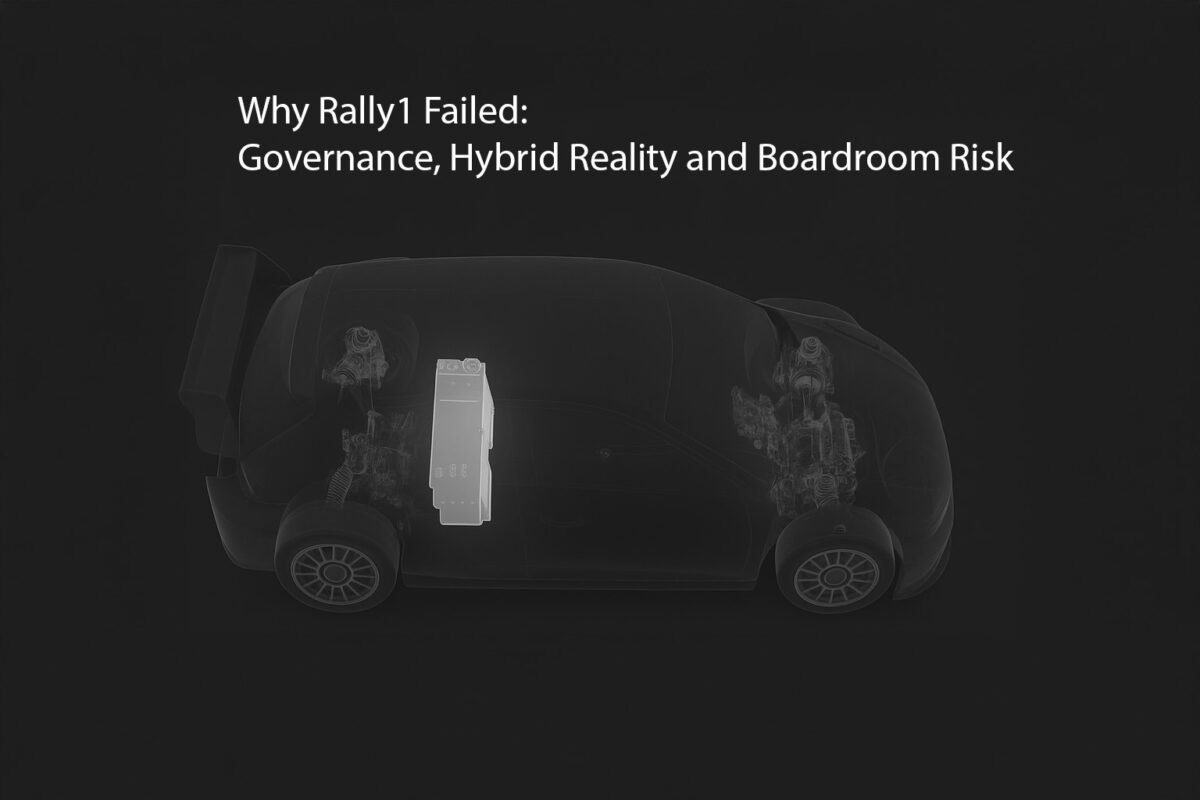

The FIA’s confirmation of the WRC27 technical regulations is more than a rulebook update. It is an admission. An admission that the Rally1 era, while technologically impressive, has failed to deliver a sustainable commercial ecosystem. An admission that cost, complexity, and isolation at the top level have quietly eroded the championship’s depth. And, most importantly, an admission that without structural change, manufacturer participation will continue to decline. WRC27 is therefore not about nostalgia, nor about “going backwards.” It is about rebuilding a viable top class around principles that modern manufacturers and modern boards can support.
What is really changing with WRC27
The headline is well known: from 2027, the top class will be based on a Rally2-derived technical foundation, with a cost-capped car, controlled components, and a simplified architecture. But focusing only on the technical elements misses the point.
WRC27 is a business model correction disguised as a regulation set.
The Rally1 concept assumed that manufacturers would accept high bespoke engineering cost in exchange for freedom, innovation, and exclusivity. That assumption proved wrong. Budgets escalated, grids stagnated, and the ecosystem around the top class (customers, private teams, secondary entries) collapsed.
WRC27 reverses that logic.
Instead of exclusivity, it prioritizes scalability.
Instead of bespoke complexity, it prioritizes repeatability.
Instead of a factory-only elite, it rebuilds a market.
The positive case: why WRC27 could work
1. Cost control that is finally structural, not cosmetic
Previous cost-reduction efforts targeted symptoms: test limits, part restrictions, headcount rules. WRC27 targets the root cause: bespoke engineering.
By anchoring the top class to Rally2 components and architectures, development becomes evolutionary rather than revolutionary. This immediately lowers:
- R&D spend
- Validation cycles
- Parts proliferation
- Operational fragility
More importantly, it allows manufacturers to forecast costs with far greater accuracy — something boards value more than raw budget reduction.
Predictability is power.
2. The return of customers — and with them, relevance
A top class without customers is not a category; it is a closed exhibition.
WRC27 reopens the door to customer participation by design. Controlled pricing, durability targets, and component commonality make it possible ,not guaranteed, but possible for private teams to operate at the highest level.
This matters far beyond grid numbers.
Customers:
- Justify production runs
- Stabilise supplier relationships
- Create secondary narratives
- Reduce political dependency on a handful of OEMs
Historically, WRC thrived when strong private teams could challenge factory entries. WRC27 gives that dynamic a chance to return.
3. Brand differentiation is back on the table
One of the most underestimated aspects of WRC27 is bodywork freedom.
Allowing multiple body styles, production-derived silhouettes, and even bespoke rally concepts gives manufacturers something they have lacked for years: visual identity.
In an era where motorsport content is consumed first through screens, brand recognition on stage is not a luxury — it is the product.
If managed correctly, WRC27 can deliver cars that look different, feel different, and tell different stories. That is essential for sponsors, media, and fans alike.
4. Strategic flexibility in a fragmented automotive future
The powertrain roadmap is deliberately open. Sustainable-fuel internal combustion initially, with room for hybrid or electric evolution later.
This matters because no OEM today has a single, stable global powertrain strategy. Regulation optionality reduces the risk of committing to a championship that becomes politically inconvenient halfway through its lifecycle.
Flexibility does not guarantee participation, but rigidity guarantees exits.
The risks: where WRC27 can fail
1. If the top class no longer feels “top”
A Rally2-based car must still feel like the pinnacle of rallying.
If performance gaps are too small, if the spectacle feels diluted, or if technical differentiation is imperceptible, the championship risks devaluing its own hierarchy.
Fans may accept cheaper cars. They will not accept an unclear narrative.
The top class must remain aspirational, in speed, aggression, and presence.
2. If openness turns into sameness
Freedom without direction produces convergence.
If bodywork flexibility results in visually similar cars, or if teams gravitate toward identical aero solutions, the opportunity for brand expression will be wasted.
This is not a regulation issue alone; it is a governance issue. The FIA must actively protect diversity, not assume it will happen organically.
3. If customer obligations become a hidden cost trap
Manufacturers will still carry responsibilities:
- Homologation
- Production volumes
- Parts availability
- Technical support
If these are poorly defined or underpriced, the “cheap car” becomes an expensive programme through the back door.
WRC27 succeeds only if customer racing is economically neutral or positive, not a loss leader justified by marketing rhetoric.
The real question WRC27 forces onto manufacturers
The most important shift is not technical. It is organisational.
WRC27 quietly changes the fundamental question from:
“Can we afford to run a factory team?”
to
“How should we participate in WRC?”
This is a critical distinction.
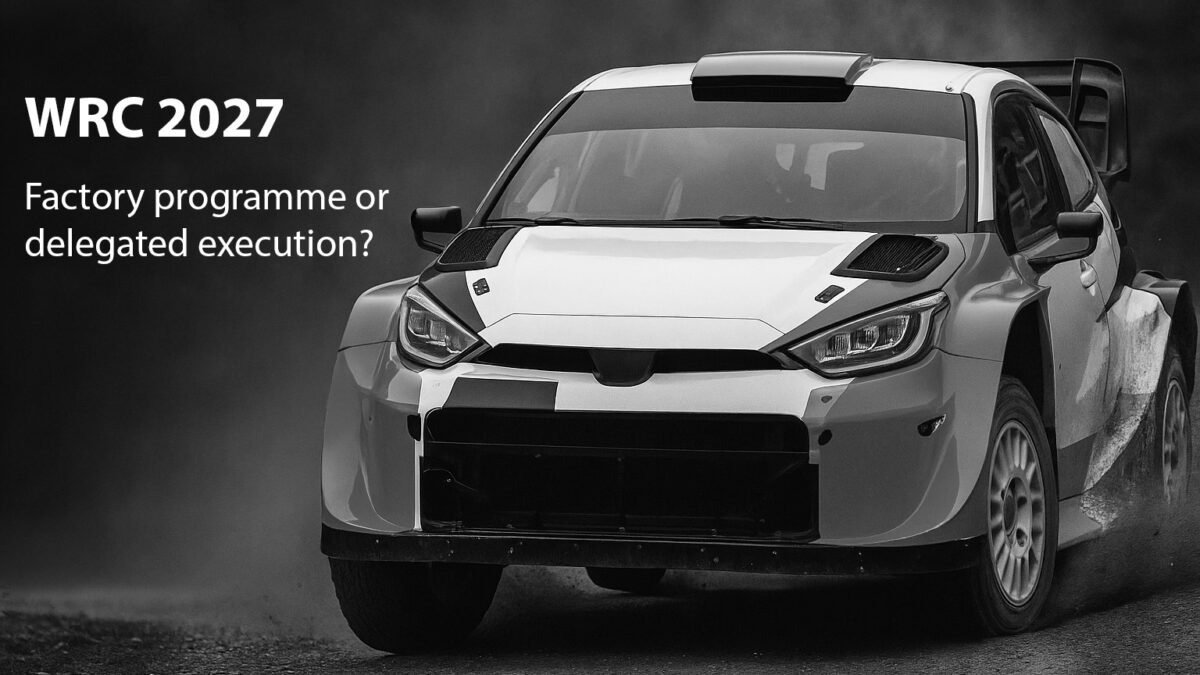
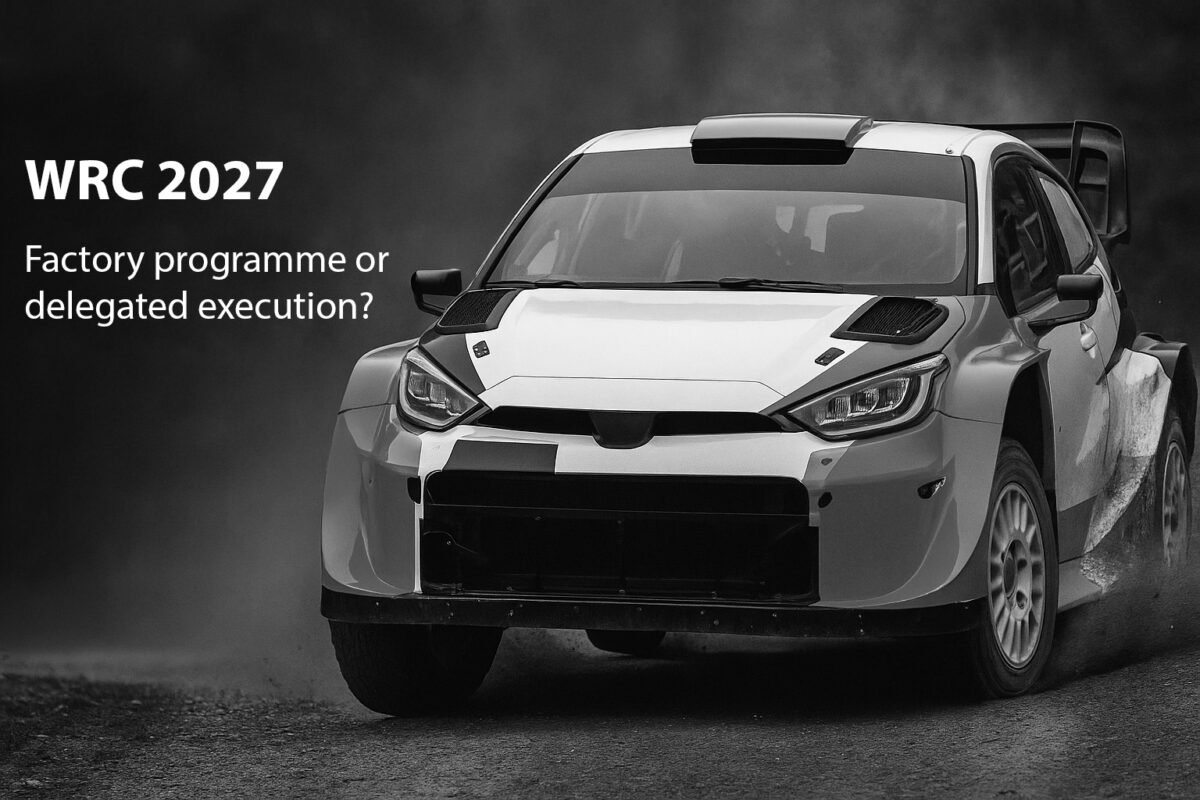
Factory team vs delegated execution: the new fault line
For many manufacturers, the Rally1 era forced a binary choice: full works team or nothing.
WRC27 introduces a third path, one that aligns far better with modern corporate logic.
A manufacturer can:
- Own the car concept and brand
- Control homologation and technical governance
- Retain strategic decision-making
While delegating day-to-day sporting execution to a professional private operator.
This reduces fixed cost, increases flexibility, and allows manufacturers to scale involvement up or down without destroying the programme.
It also creates accountability through contracts, KPIs, and performance incentives — something internal motorsport departments often struggle to enforce.
The uncomfortable truth
WRC does not need manufacturers who want to race.
It needs manufacturers who can sustain participation.
WRC27 does not guarantee that outcome. But it finally aligns the sport with economic reality. If manufacturers apply old factory logic to a new regulatory ecosystem, they will still overpay, just less visibly.
If they adapt their operating models, WRC27 can mark the first genuine expansion opportunity the championship has seen in years.
Cheaper cars alone will not save rallying. Smarter structures might.
Where Nine Vision fits in this new era
WRC27 does not fail or succeed on regulations alone, it succeeds or fails on execution. This is where Nine Vision operates.
We support manufacturers in defining how to enter WRC27:
- selecting the right participation model,
- structuring OEM–partner relationships,
- designing governance and cost-control frameworks,
- aligning sporting ambition with board-level financial logic.
The new era of WRC will reward those who prepare early, structure intelligently, and execute with discipline. Nine Vision exists to make that transition deliberate, controlled, and sustainable.